
Management as Infrastructure
On the relational work of managers and what happens when they’re gone.

I've been a manager. I've had many managers. And I've spent enough time at work to know exactly the amount of invisible labor they do to impact performance and retention. The data backs me up.
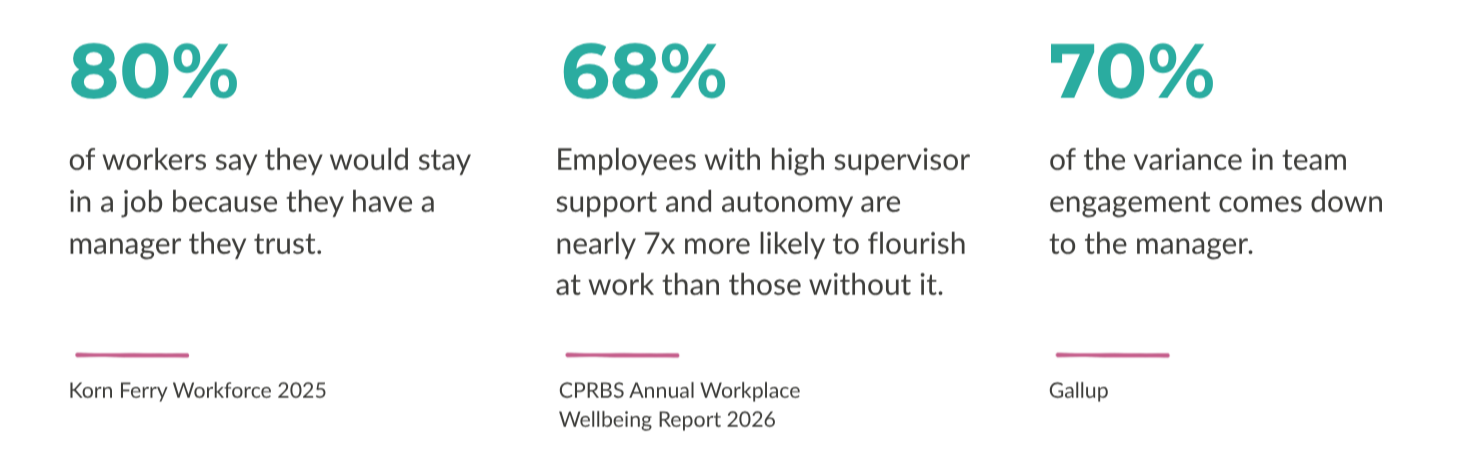
And yet, the conversation happening in many organizations right now isn't about how to invest in managers. It's about how many to cut.
In 2023, middle managers made up one-third of corporate layoffs. In 2025, 41% of employees said their companies trimmed management layers. Gartner predicted that this year, 20% of organizations would use AI to eliminate more than half of their middle management positions. Seems like we're well on our way if we're not there already. Gartner's own analysts are now saying that workforce reductions may create budget room, but they do not create return. I could not agree more and find myself wondering what the logic is behind these decisions.
The case for so drastically cutting managers must assume their primary function is relaying information up and down a hierarchy, monitoring compliance, and approving things. If that's all management is, the math makes sense. But that's not what management is—or at least, it's not what it's supposed to be.
Management, done well, is human infrastructure work. It's the relational labor that keeps teams functioning. It's the unwritten stuff that isn't documented in the project plan. Things like:
- Noticing when someone is struggling before they say so.
- Translating an organizational decision into meaning at the team level.
- Creating the conditions in which people are willing to speak up, ask for help, and admit mistakes.
- Catching the early signs of disengagement before they become a retention problem.
- Managing conflict before it devolves into dysfunction.
- Recognizing contributions in ways that are meaningful to the contributors.
When this work disappears, bet it will show up months later in the employee engagement scores, turnover data, and meetings where nobody says what they're thinking.
Korn Ferry's 2025 survey of 15,000 professionals found that the absence of adequate management left 37% of employees feeling directionless and 43% saying their leaders lacked alignment. The managers who remained were absorbing more—constantly putting out fires, not supporting and developing people.
And Gallup just told us that manager engagement has dropped nine points since 2022—its steepest decline in years. It's no surprise that with their numbers dwindling they feel unsupported, overextended, and unclear on their mission.
To be fair, some organizations do have an outsized management layer. Others are facing financial pressure and need to make tough calls. Cutting manager positions is sometimes the necessary decision, but the organizations that can continue to thrive in those situations are those that are aware of the hidden costs and have a plan to fill the gaps left behind.
The relational work of management is foundational. It holds the organization up. You can reorganize it, but the foundation has to stay intact or the whole structure collapses.
Oops I missed an opportunity for a tree metaphor. If you pull up the roots, the whole tree comes with. You get the message.