
Do I Matter?
The most overlooked driver of performance.

Every person at work is carrying a quiet question:
Do I matter here?
Feeling seen is one of our most fundamental human needs. In a workplace context, it is a powerful and under-leveraged driver of performance, retention, and job satisfaction. With only 31% of U.S. employees actively engaged at work, leaders have an opportunity to move the needle by ensuring people know they matter.
Years ago, in my direct service days, I worked with someone I’ll call Amari. Before coming to the United States, Amari was deeply respected in his community. He was the person others turned to for advice, for a loan, for a laugh. When he fled violence and arrived here, everything shifted. No family. No community. No one who knew his story. When he walked down the street, he felt invisible. So, I shouldn’t have been surprised when he told me that our meeting was his favorite part of the week.
As a young professional, my ego soared. But when he told me why, I nearly fell out of my chair:
“Because you’re always smiling when I arrive.”
I had assumed it was because of my burgeoning clinical skills, the advocacy and resources my organization provided, the problem-solving work we did together. Instead, it was the small signal that I was glad he was there.
That smile communicated:
You belong.
I see you.
You matter.
Every outcome we achieved together rested on his experience of dignity. That realization changed how I lead.
***
What Does This Have to Do With Workplace Performance?
Everything.
In the 1920s, Harvard researchers studying productivity at Western Electric’s Hawthorne Works plant outside Chicago discovered something unexpected. Productivity improved when lighting increased. But it also improved when lighting decreased. And even when it stayed the same. While interpretations of the research have evolved over time, one enduring lesson remains: attention influences how people perform.
None of this ignores the reality that many workplaces are under strain. Burnout is real. Resources are tight. And I cannot overstate how heavily the broader social, economic, and political climate weighs on people inside organizations. There are structural issues that require structural solutions.
In the midst of that complexity, micro-signals of dignity are foundational infrastructure.
The Complexity Bias
We often assume that engagement and retention require massive initiatives, new frameworks, or long timelines. Many changes do. But one of the most powerful levers available to any organization is profoundly simple: Notice and acknowledge people.
Not vaguely. Specifically:
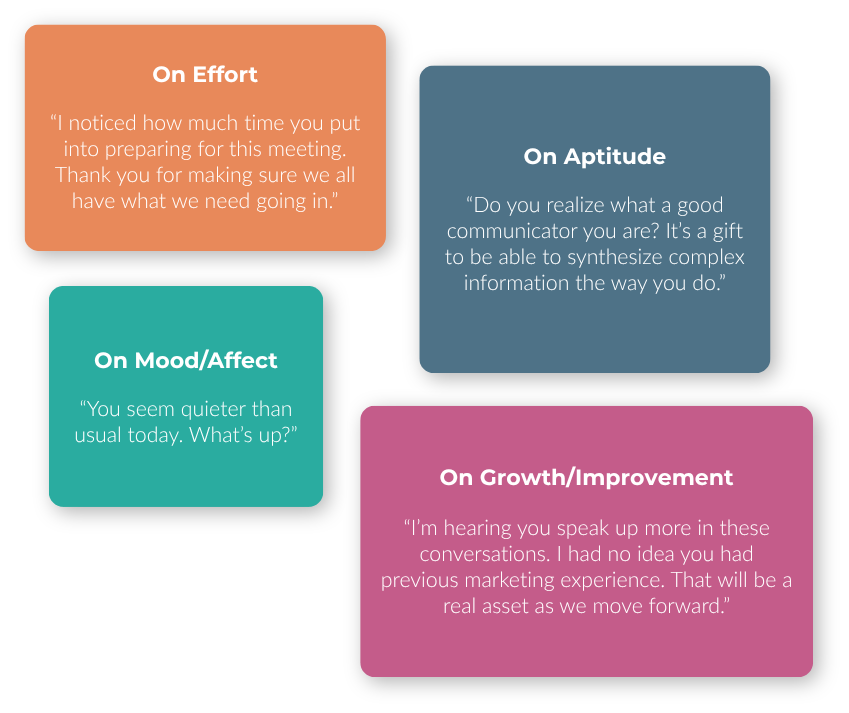
I’ve seen this pattern again and again. When someone feels seen, it changes how they perform, how they engage with others, and how fully they lean into growth.
***
Why It Matters Strategically
Mattering is not a soft metric—it is an operational essential. As Zach Mercurio argues in The Power of Mattering, feeling noticed, affirmed, and needed fundamentally shapes how people show up at work.
Research in organizational behavior consistently shows that when people feel seen:
They contribute ideas more freely.
They take initiative.
They give discretionary effort.
They stay longer.
When people feel repeatedly unseen:
They disengage.
They withhold insight.
They do the minimum.
They leave.
The question “Do I matter?” sits underneath all of it. And everyone—regardless of their role—has the power to influence the answer for someone else.
Small signals compound.
A Simple Practice
What would shift if you made it a habit to:
Acknowledge effort—even when the outcome is still unfolding?
Name a specific strength you see in someone?
Reflect back the emotional tone someone brings to a room and why it matters?
Ask a question that signals you believe someone is capable of more?
Culture isn’t built only through initiatives. It’s built through daily signals about who and what matters.
*Originally published on LinkedIn