
Urgency Culture Doesn’t Need a Bad Boss
On internalized urgency and who pays the highest price.

I know someone who faked a hurricane to take an extra day of vacation.
Did she have enough accrued PTO? Yes. Had anyone asked her not to take a full week off? No.
And yet—there we were in the hotel office making a long-distance phone call instead of visiting wounded toucans at the wildlife sanctuary where we should have been.
I've done my own version of this. I rescheduled a trip because of a high-profile visit from a government leader. No one pressured me. I weighed the options and decided the visit was too important to miss. Honestly? I'd make the same call again.
But I also remember calling into my $11.75/hour gym manager job from the hospital hallway where my grandmother was dying, when, in fact, my boss had given me explicit permission to take all the time I needed. That one I'd handle very differently today.
We talk a lot about toxic bosses and broken cultures—and those are real. But one of the patterns I keep coming back to is this:
How often are we doing it to ourselves?
My stories are about the version of this I experienced—the internalized urgency of someone with enough positional power to have chosen differently. But urgency culture is something researchers and practitioners have been examining at a much deeper level—and no one has named it more precisely than Dr. Tema Okun, whose work identifies constant urgency as a defining characteristic of white supremacy culture: the way it crowds out inclusive processes, keeps us moving too fast to hear from the people who most need to be heard, and makes it nearly impossible to pause and ask whether this is working. What starts as organizational pressure has a way of becoming something people internalize so thoroughly that they enforce it on themselves long after anyone asked them to. And the costs of that—who gets heard, who gets to slow down, who carries the weight of always being available—are not equally distributed.
Leila Billing and Natalie Brook at We Are Feminist Leaders have developed a set of reflection questions for teams that I keep coming back to:
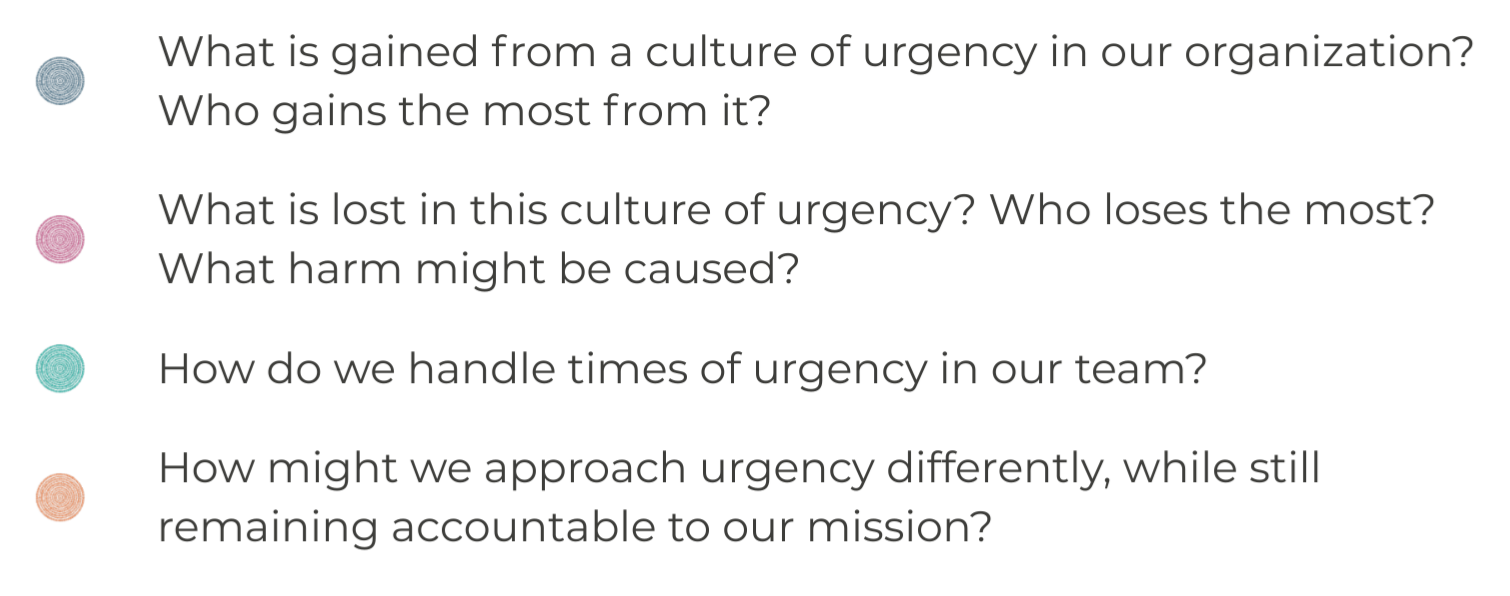
That last question really gets me thinking, because urgency isn't always wrong. Sometimes it's exactly right. The work is learning to tell the difference—and building organizations where people don't feel they have to fake a hurricane in either case.
*Originally published on LinkedIn